


Baseline
Research Problem
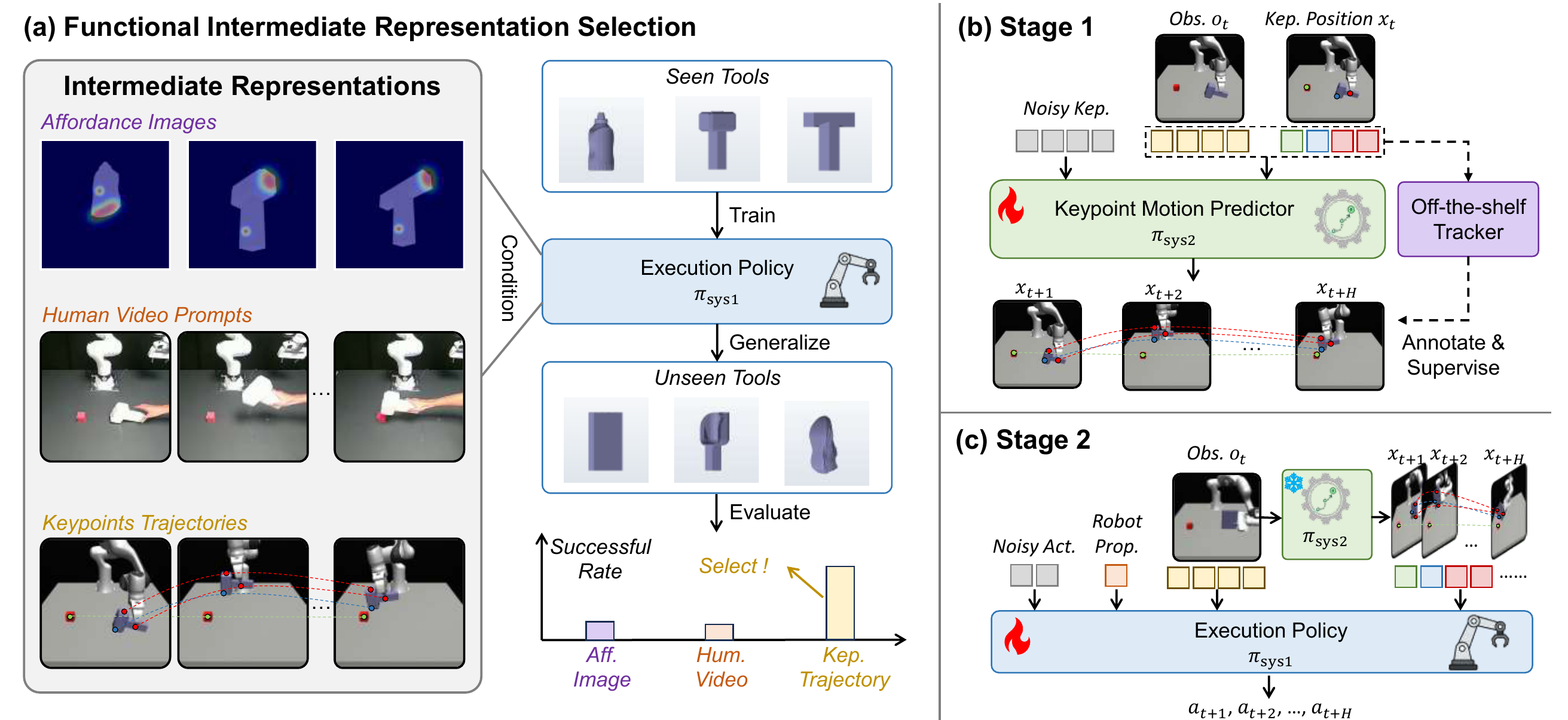
We define functional generalization as the ability to repurpose diverse tools to achieve the same function. While humans can effortlessly adapt their actions across tools with different shapes and affordances, robots still struggle to transfer functional intent from perception to control. FORGE addresses this challenge by learning functional intermediate representations that bridge visual understanding and grounded action, enabling robots to accomplish the same function with arbitrary tools.
Overview of FORGE
Demos
Simulation Demos
Scoop
ATM
FORGE (ours)
Shoe
Baseline
ATM
FORGE (ours)
Book
Baseline
ATM
FORGE (ours)
FM and ATM often fail to hit the target with the specified hitting points.
FORGE succeeds more reliably with predicting keypoint trajectories.
Real-World Demos
Tobject
Hitting Pattern 1
FM
FORGE (ours)
Hitting Pattern 1 requires the policy to hit the target with the hammer-like head, the FM baseline incorrectly uses the handle to strike the target.
Hitting Pattern 2
FM
FORGE (ours)
Hitting Pattern 2 requires the policy to hit the target with the handle, the FM baseline misses the hit.
Shoe
Hitting Pattern 1
FM
FORGE (ours)
Hitting Pattern 1 requires the policy to hit the target with the front point of the shoe, the FM baseline misses the hit.
Hitting Pattern 2
FM
FORGE (ours)
Hitting Pattern 2 requires the policy to hit the target with the rear point of the shoe, the FM baseline misses the hit.
Book
Hitting Pattern 1
FM
FORGE (ours)
Hitting Pattern 1 requires the policy to hit the target with the bottom edge, the FM baseline fails to complete the downward motion.
Hitting Pattern 2
FM
FORGE (ours)
Hitting Pattern 2 requires the policy to hit the target with the book spine, the FM baseline misses the hit.
Results
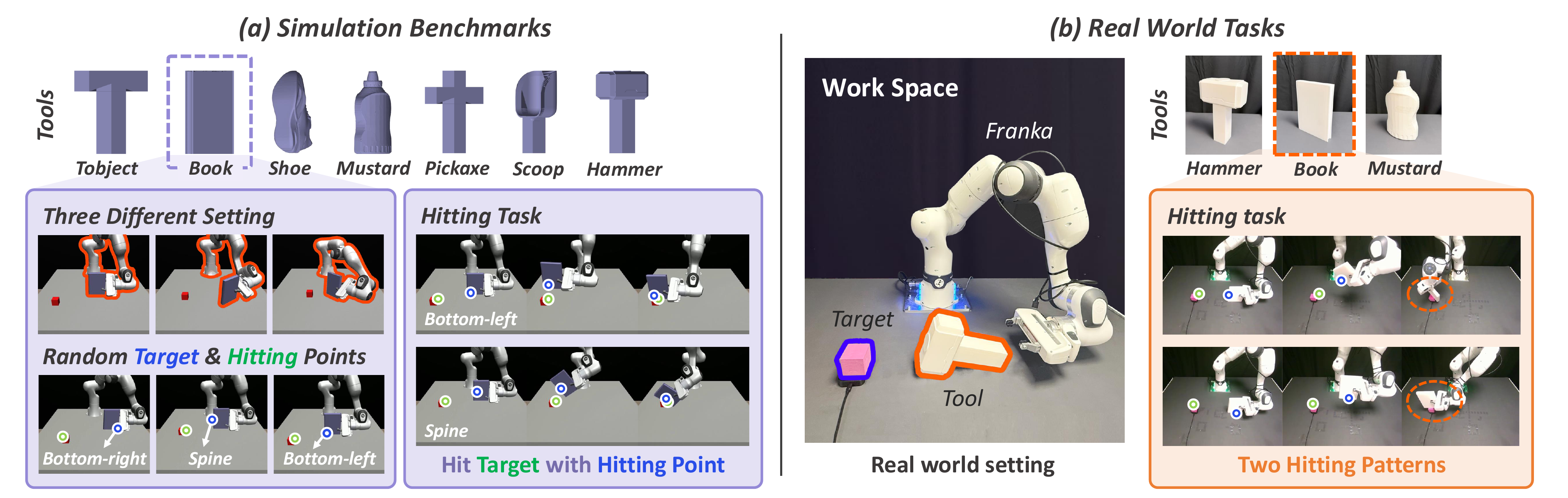
Simulation Results

Real-World Results
