

FuncBridge: Towards Functional Tool-Use Generalization via Keypoint Trajectory Reasoning

Chuhao Zhou1 Liquan Wang2 Shuxin Cao2 Xiangyu Chen1 Yuxuan Hu1 Boyu Ma1 Animesh Garg2 Jianfei Yang1,*
1MARS Lab, Nanyang Technological University 2Georgia Institute of Technology *Corresponding Author
MARS Lab logo Nanyang Technological University logo Georgia Institute of Technology logo

Research Problem

We define functional generalization as the ability to repurpose diverse tools to achieve the same function. While humans can effortlessly adapt their actions across tools with different shapes and affordances, robots still struggle to transfer functional intent from perception to control. FuncBridge addresses this challenge by learning functional intermediate representations that bridge visual understanding and grounded action, enabling robots to accomplish the same function with arbitrary tools.

Overview of FuncBridge

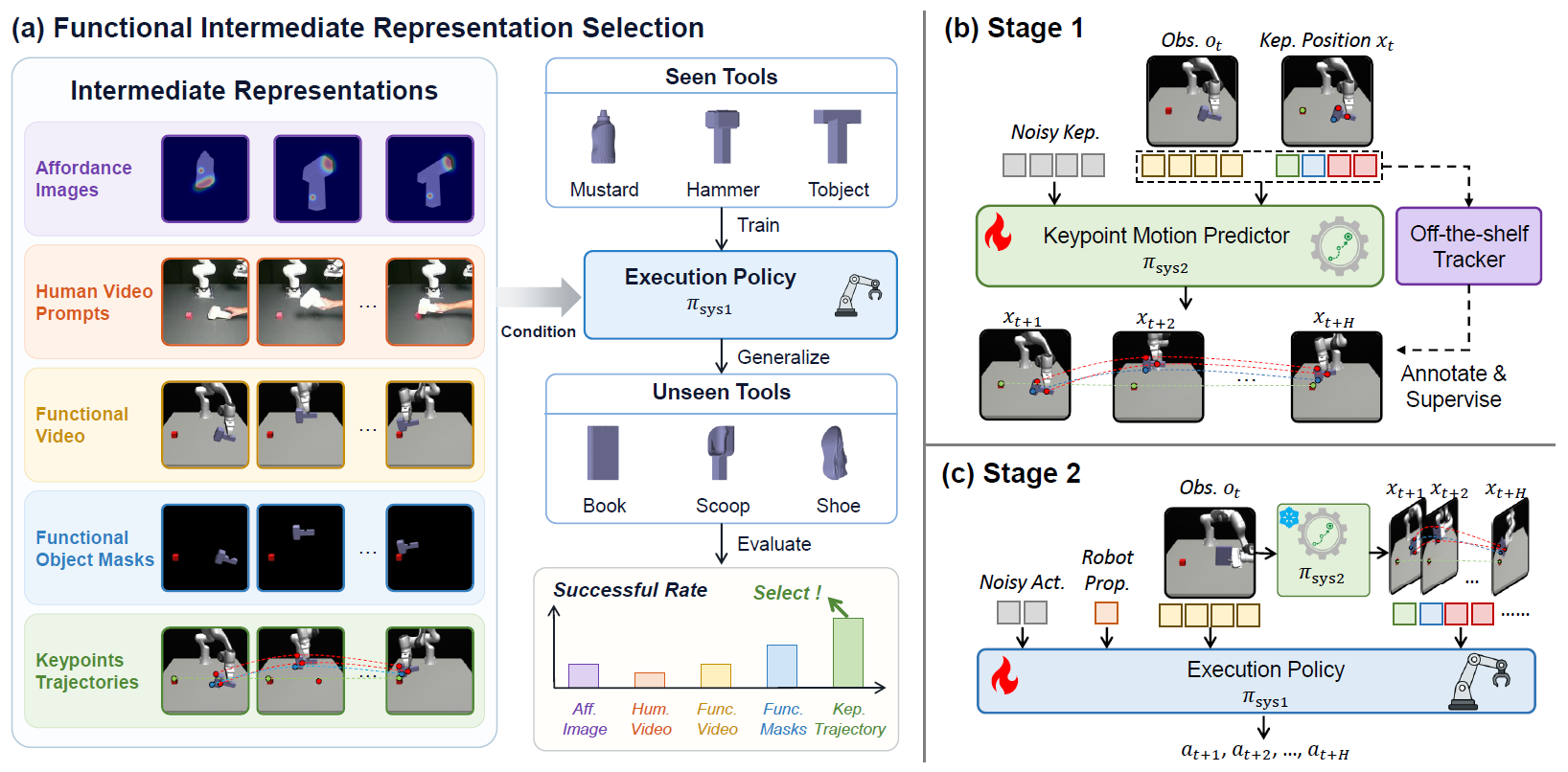
FuncBridge method overview
Overview of FuncBridge. (a) Evaluation and selection of functional intermediate representations. (b) In Stage 1, the System-2 planner learns to predict future keypoint-based functional plans from action-free observations. (c) In Stage 2, the System-1 execution policy grounds the predicted functional plans into executable robot actions.

Simulation Demos

Three functions, three unseen tools. Compare FM, ATM, and FuncBridge on the same tool-use task.

Hitting

Strike the red cube with the designated hitting point, adapting the motion to each unseen tool.

Scoop

FM
ATM
FuncBridge (ours)

Shoe

FM
ATM
FuncBridge (ours)

Book

FM
ATM
FuncBridge (ours)

FM and ATM can pass over the target, miss the specified hitting point, or drop the tool. FuncBridge predicts function-aware keypoint trajectories to align the hitting region and complete the strike.

Sweeping

Push the blue cylinder with the designated sweeping point while maintaining the required contact.

Scoop

FM
ATM
FuncBridge (ours)

Shoe

FM
ATM
FuncBridge (ours)

Book

FM
ATM
FuncBridge (ours)

FM and ATM can pass over the target, sweep imprecisely, or drop the tool. FuncBridge guides the sweeping point toward the cylinder and carries through the pushing motion.

Hooking

Pull the green ball inward with the designated hooking point, coordinating alignment and the pulling motion.

Scoop

FM
ATM
FuncBridge (ours)

Shoe

FM
ATM
FuncBridge (ours)

Book

FM
ATM
FuncBridge (ours)

FM and ATM can pass over the target, hook imprecisely, or drop the tool. FuncBridge aligns the functional region with the ball and follows through with an inward pull.

Real-World Demos

Functional generalization on a Franka robot. Compare FM and FuncBridge across unseen tools and two patterns per function.

Hitting

Use the specified part of each unseen tool to strike the target. Each tool is evaluated with two hitting patterns.

Tobject

Hitting Pattern 1
FM
FuncBridge (ours)

Hitting Pattern 1 requires a strike with the hammer-like head. FM incorrectly uses the handle. FuncBridge strikes with the specified head.

Hitting Pattern 2
FM
FuncBridge (ours)

Hitting Pattern 2 requires a strike with the handle. FM misses the hit. FuncBridge aligns the handle with the target and completes the strike.
Shoe

Hitting Pattern 1
FM
FuncBridge (ours)

Hitting Pattern 1 requires a strike with the front of the shoe. FM misses the hit. FuncBridge brings the specified front point onto the target.

Hitting Pattern 2
FM
FuncBridge (ours)

Hitting Pattern 2 requires a strike with the rear of the shoe. FM misses the hit. FuncBridge adjusts the motion to strike with the rear point.

Book

Hitting Pattern 1
FM
FuncBridge (ours)

Hitting Pattern 1 requires a strike with the bottom edge. FM fails to complete the downward motion. FuncBridge follows through to hit the target.

Hitting Pattern 2
FM
FuncBridge (ours)

Hitting Pattern 2 requires a strike with the book spine. FM misses the hit. FuncBridge aligns the spine and completes the strike.

Sweeping

Repurpose an unseen book to sweep the target using two different functional patterns.

Book

Sweeping Pattern 1
FM
FuncBridge (ours)

Sweeping Pattern 1 requires the book to contact and push the target along the specified sweep. FM misses the sweep. FuncBridge aligns the book with the target and completes the pushing motion.

Sweeping Pattern 2
FM
FuncBridge (ours)

Sweeping Pattern 2 requires a different sweeping region and motion. FM uses the wrong sweeping pattern. FuncBridge follows the specified pattern to sweep the target.

Hooking

Repurpose an unseen book to hook and pull the target inward using two different functional patterns.

Book

Hooking Pattern 1
FM
FuncBridge (ours)

Hooking Pattern 1 requires the book to engage the target and pull it inward. FM misses the hook. FuncBridge aligns the hooking region and completes the inward pull.

Hooking Pattern 2
FM
FuncBridge (ours)

Hooking Pattern 2 requires a different hooking region and motion. FM does not complete the hook. FuncBridge maintains the interaction and follows through with the pull.

Results

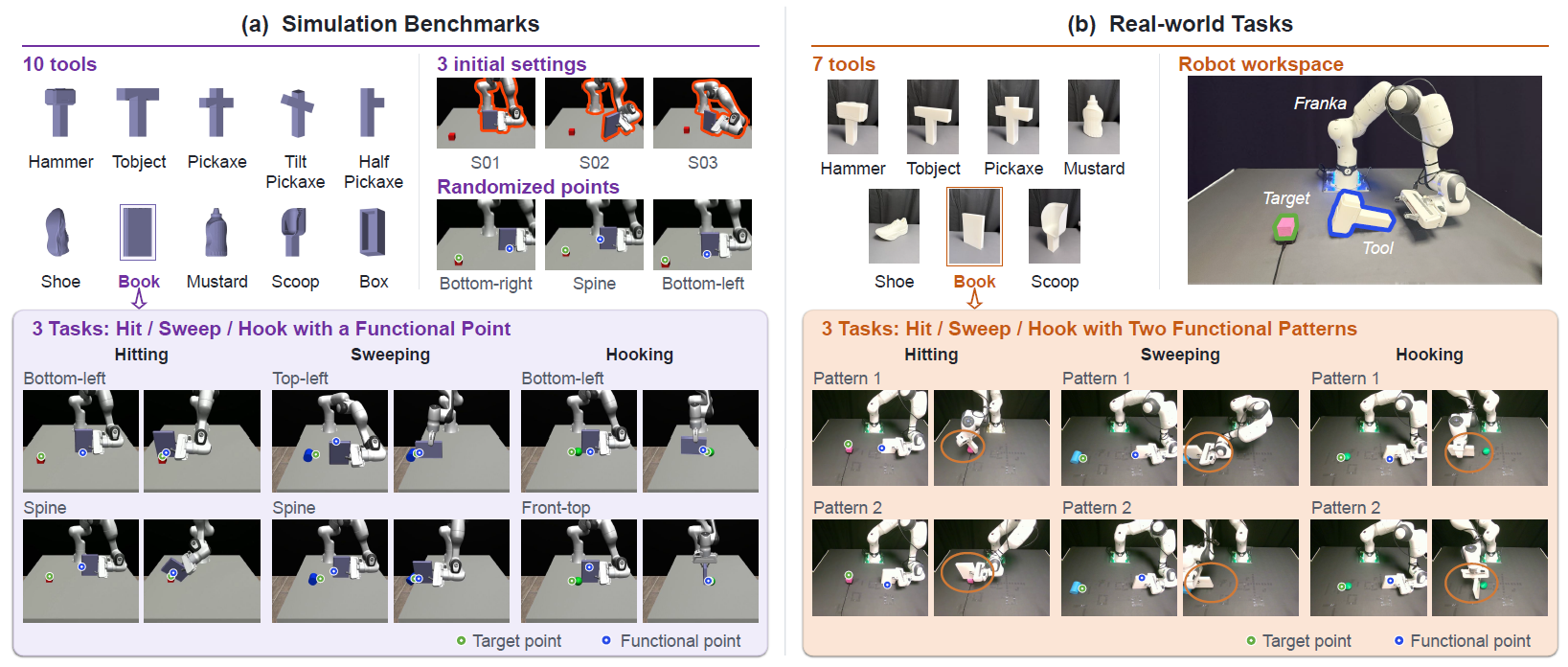
Simulation benchmark with 10 tools and real-world benchmark with 7 tools, spanning hitting, sweeping, and hooking
Simulation Benchmark and Real-World Setting. (a) The simulation benchmark spans 10 tools and three functions—hitting, sweeping, and hooking—with three initial settings per tool and randomized functional and target points. (b) The real-world benchmark uses a Franka robot with 7 tools and the same three functions, each evaluated under two functional patterns.

Simulation Results

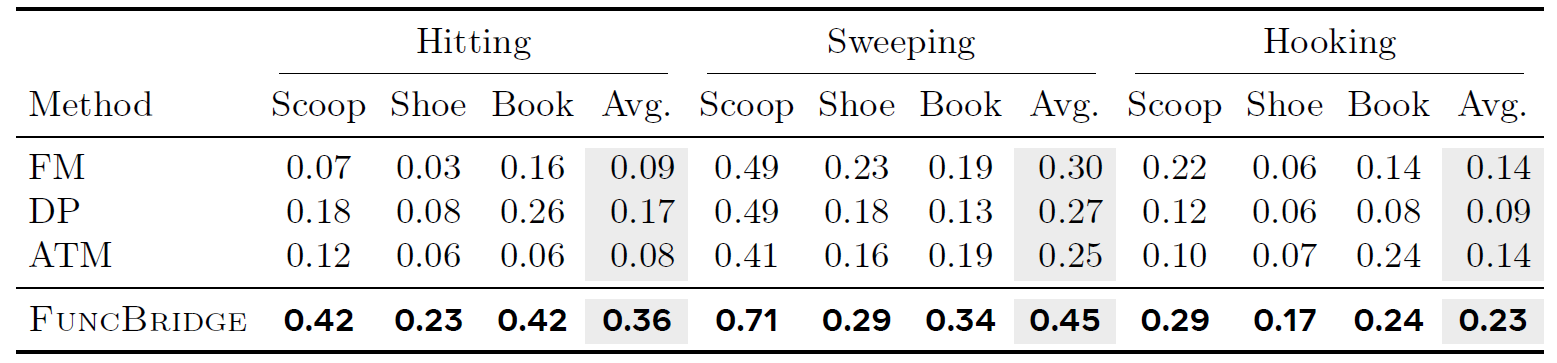
Simulation success rates for hitting, sweeping, and hooking on Scoop, Shoe, and Book View full-size table
We train on action-labeled data from four tools and evaluate on three unseen tools (Scoop, Shoe, and Book) across hitting, sweeping, and hooking. Each tool-function pair is tested under three initial settings with 30 rollouts per setting. FuncBridge achieves average success rates of 0.36 for hitting, 0.45 for sweeping, and 0.23 for hooking, compared with the best baseline results of 0.17, 0.30, and 0.14, respectively. These results show that function-aware keypoint plans provide effective guidance for adapting motions to unseen tool geometries.

Real-World Results

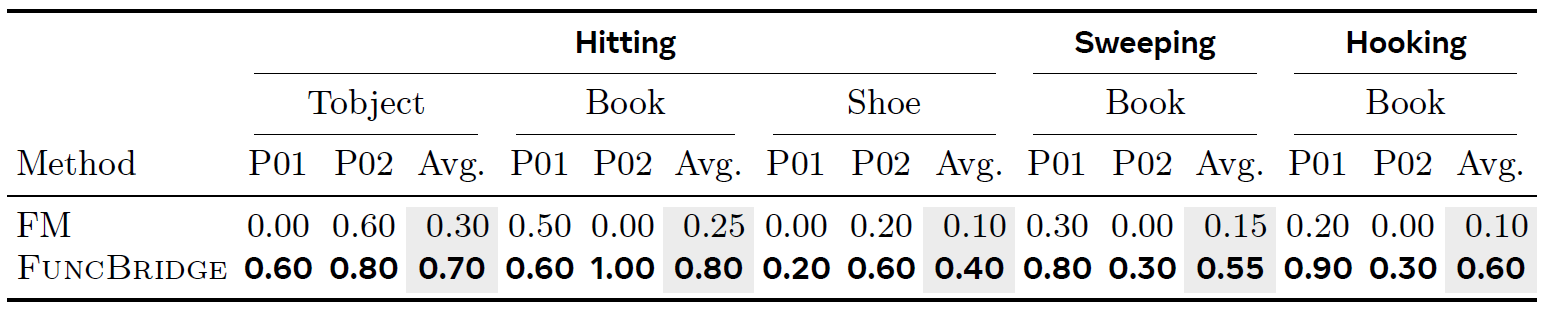
Real-world success rates for hitting on Tobject, Book, and Shoe, and sweeping and hooking on Book View full-size table
For hitting, we train on Hammer, Pickaxe, and Mustard and evaluate on Tobject, Book, and Shoe. For sweeping and hooking, we train on Hammer and Mustard and evaluate on the unseen Book. Each functional pattern is tested with 10 rollouts. Averaged across the evaluated tools and patterns, FuncBridge achieves 0.63 for hitting, 0.55 for sweeping, and 0.60 for hooking, versus 0.22, 0.15, and 0.10 for FM. FuncBridge outperforms FM in every evaluated tool-pattern setting, demonstrating more reliable functional generalization on the real robot.